The Holy Three Hierarchs
St. Nikolai Velimirovic — The Prologue of Ohrid
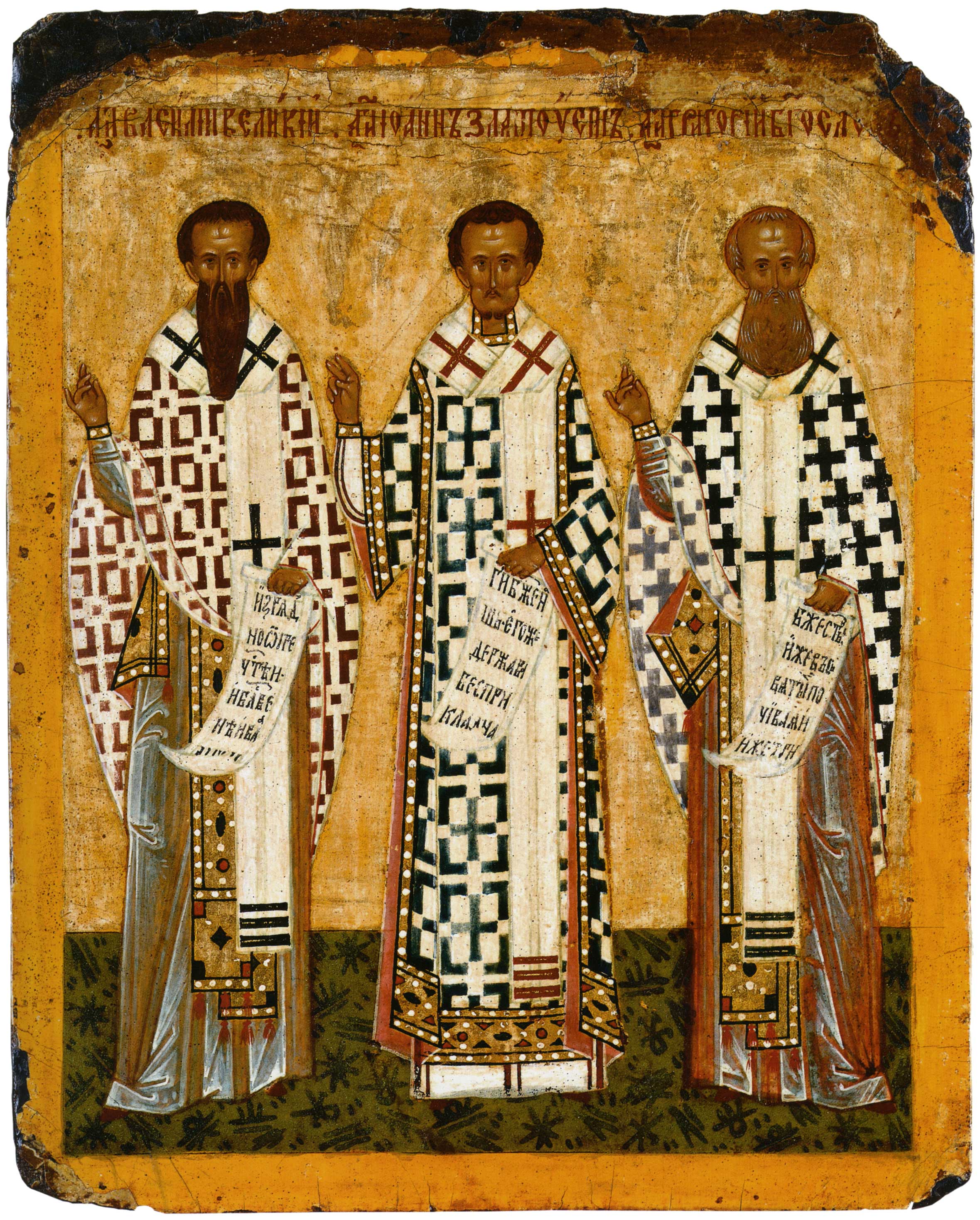
The saints Basil the Great, Gregory the Nazianzus, and John Chrysostom each have their own feast day in the month of January: Basil the Great on January 1 (January 14), Gregory the Nazianzus on January 25 (February 7), and John Chrysostom on January 27 (February 9). However, their common feast day was established in the 11th century during the reign of Emperor Alexios I Komnenos.
At one time, a dispute arose among the people concerning which of these three was the greatest. Some praised Basil for his purity and courage; others praised Gregory for the incomparable depth and loftiness of his theological wisdom; still others praised Chrysostom for his wondrous eloquence and the clarity with which he expounded the Faith. Thus, some called themselves Basilians, others Gregorians, and still others Johannites.
By the providence of God, this dispute was resolved for the benefit of the Church and for the greater glory of the three saints. John, Bishop of Euchaita (June 14), beheld a vision in a dream: first, each of the three saints appeared to him separately, in great glory and ineffable beauty; then all three appeared together. They said to him:
“We are one in God, as you see, and there is nothing contradictory among us… nor is there among us a first or a second.”
The saints also instructed Bishop John to compose a common liturgical service in their honor and to establish a single feast day for all three. As a result of this wondrous vision, the dispute was resolved by appointing January 30 (February 12) as the common feast day of the Three Hierarchs.
The Greek people regard this feast not only as an ecclesiastical celebration, but also as their greatest national and educational holiday.
January 1 (January 14)
St. Basil the Great
Saint Basil the Great (January 1 / January 14), Archbishop of Caesarea. He was born during the reign of Emperor Constantine. While still unbaptized, he spent fifteen years studying in Athens, mastering philosophy, rhetoric, astronomy, and all the secular sciences of that era. Among his school companions were Gregory the Theologian and Julian, who would later become the Apostate Emperor. In his mature years, he was baptized in the River Jordan alongside his former teacher, Eubulus. He served as Bishop of Caesarea in Cappadocia for nearly ten years, departing this earthly life at the age of fifty. As a great champion of Orthodoxy, a brilliant luminary of moral purity and religious fervor, a profound theological mind, and a magnificent builder and pillar of the Church of God—Basil is rightfully called the Great. In the Church's divine services, he is hailed as the bee of the Church of Christ, who brings honey to the faithful and stings heretics with his sting. Numerous works of this Father of the Church have been preserved—theological, apologetic, ascetic, and canonical—as well as the divine liturgy named after him, the Liturgy of Saint Basil the Great. This service is served ten times a year: on January 1st, on the eves of Christmas and Theophany, on every Sunday of the Great Lent except Palm Sunday, and on Holy Thursday and Holy Saturday. Saint Basil fell asleep in the Lord on January 1st, 379, and entered the Kingdom of Christ.
January 25 (February 7)
St. Gregory the Theologian
St. Gregory the Theologian (January 25 / February 7), Archbishop of Constantinople, was born in Nazianzus to a Greek father and a Christian mother. Long before his baptism, he studied in Athens together with Basil the Great and Julian the Apostate. He frequently foretold that Julian would one day abandon the faith and persecute the Church—a prophecy that later came true. Gregory’s life was profoundly shaped by his pious mother, Nonna. After completing his education, Gregory received holy baptism. St. Basil ordained him Bishop of Sasima, and Emperor Theodosius the Great soon called him to occupy the vacant see of Constantinople. He authored a vast number of works, with his theological writings becoming the most celebrated, earning him the title 'the Theologian.' His Theological Orations on the Holy Trinity is especially renowned for its spiritual depth. He actively wrote against the heretic Macedonius, who falsely claimed that the Holy Spirit was merely a creature of God, as well as against Apollinarius, who erroneously taught that Christ had no human soul, believing His divinity replaced it. He also penned refutations against Emperor Julian the Apostate, his former classmate. When disputes regarding his election as Archbishop erupted at the Council of 381, he resigned willingly, stating: 'Those who deprive us of our throne cannot deprive us of God.' Leaving Constantinople, he returned to Nazianzus, spending his remaining years in retirement, prayer, and writing soul-edifying books. Despite lifelong fragile health, he lived to the age of eighty. His holy relics were later translated to Rome, while his head reposes in the Dormition Cathedral in Moscow. He was and remains a radiant and wondrous light of the Orthodox Church, cherished for his profound humility, purity of character, and the unmatched depth of his intellect. He reposed in the Lord in the year 390.
January 27 (February 9)
St. John Chrysostom
St. John Chrysostom (January 27 / February 9), the golden trumpet of Orthodoxy. This day marks the celebration of the translation of his holy relics from the Armenian village of Comana, where he passed away in exile, to Constantinople, where he had once led the Church as Patriarch. Three decades after his falling asleep in the Lord, Patriarch Proclus delivered a homily honoring his spiritual father and mentor. His words so deeply stirred the devotion of both the faithful and Emperor Theodosius the Younger that everyone longed to return Chrysostom’s relics to the capital. Tradition holds that the shrine could not be budged until the Emperor penned a letter to Chrysostom seeking his forgiveness—since the Emperor's own mother, Eudoxia, had caused the saint's exile—and pleading with him to return to his former residence. Once this letter of repentance was placed upon the reliquary, it became completely weightless. Along the journey, numerous sick people were healed upon touching the shrine. When the relics reached the capital, the Emperor knelt before them in prayer, begging the saint's forgiveness in his mother's name, as if she herself were speaking: 'In my earthly life, I caused you harm; but now that you dwell in immortal life, grant grace to my soul. My earthly glory has vanished and brought me no aid; sustain me, O Father, in your glory, before I face condemnation at the Judgment of Christ!' When the saint was carried into the Church of the Holy Apostles and placed upon the patriarchal throne, the gathering of the faithful heard his voice declare: 'Peace be with you.' The holy relics of St. John Chrysostom were translated in the year 438.
A Prayer to the Holy Three Hierarchs: Basil the Great, Gregory the Theologian, and John Chrysostom
Oh, most radiant luminaries of the Church of Christ, Basil, Gregory, and John, who illuminated all the ends of the earth with the light of Orthodox dogmas, and by the sword of the Word of God quenched the confusion and subversions of blasphemous heresies!
Falling before your compassion, we cry out to you from the depths of our souls with faith and love: standing before the Throne of the Most Holy, Consubstantial, Life-giving, and Undivided Trinity — for Whom you strove valiantly in word, in writing, and in life, and laid down your souls — ever intercede with Them, that They would also confirm us in Orthodoxy, in concord, in the unwavering confession of the faith of Christ even unto death, and in whole-souled obedience to His Holy Church; that The Trinity would gird us from on high with strength against all our enemies, both invisible and visible; that He would preserve His Church unshaken from unbelief, superstition, heresy, and schism; that He would grant our archpastors health, long life, and advancement in all things; that He would give our pastors spiritual sobriety and zeal for the salvation of their flock; to rulers — judgment and justice; to soldiers — patience, courage, and victory over their enemies; to the poor and widows — protection; to the sick — healing; to the young — a good upbringing in the faith; to the elderly — comfort; to the sorrowful — help; and to all, everything that is needful for temporal and eternal life; that in peace and repentance, burning with the desire for salvation, serving the Lord and struggling the good struggle, we may complete our earthly journey and be found worthy in the Heavenly Kingdom, together with you, ever to sing and glorify the Most Holy and Most Glorious Name of the Father, and of the Son, and of the Holy Spirit, unto the ages of ages.
Amen.