How We Should Behave in the Holy Church and at Divine Services
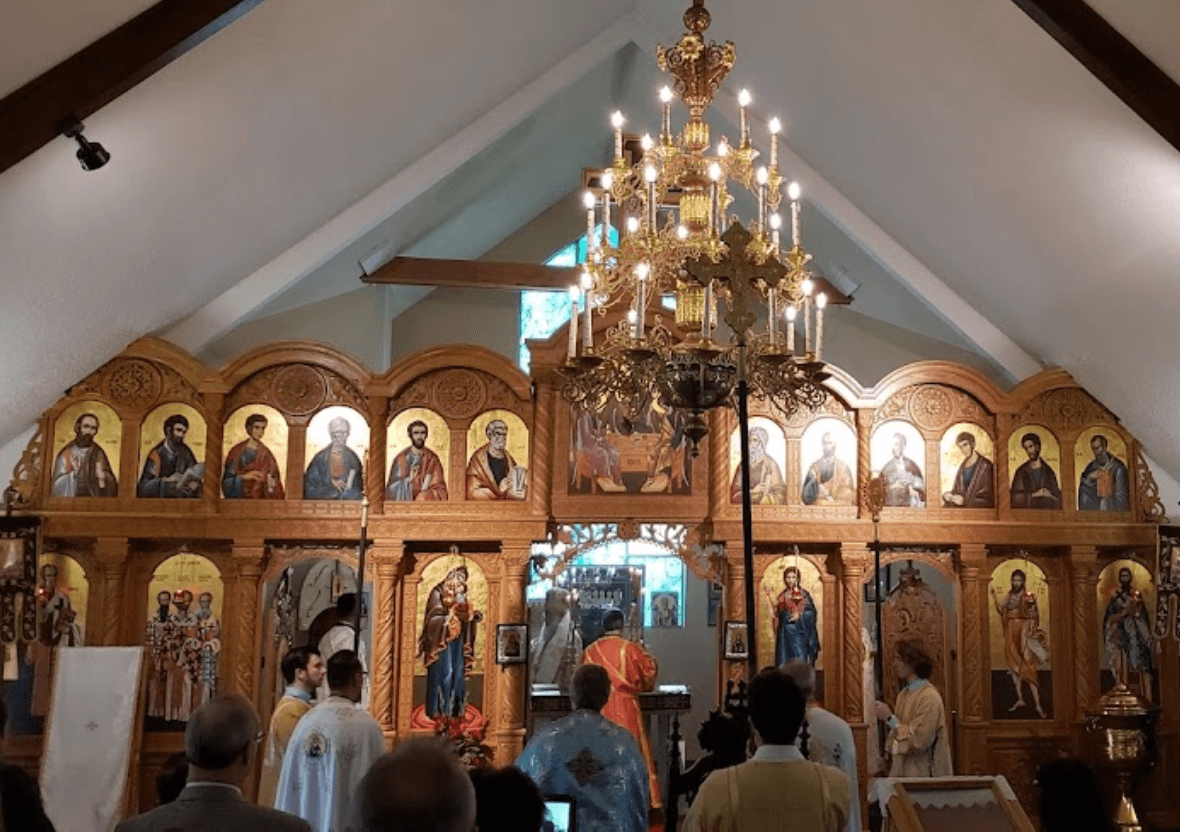
When we enter the holy church and take our place (men on the right, women on the left, with the children standing in front), let us collect ourselves, concentrate, and enter deeply into the meaning of the prayers and hymns that are being offered, guarding ourselves from all conversation and distraction, and let us set aside every earthly care and problem, striving to leave the church spiritually better and purer than when we entered it. While the service is going on, let us not walk about the church, let us not light candles or venerate icons, let us not push through the crowd, but let us follow the holy service attentively and reverently, and strive to make it as beautiful and solemn as possible.
During the reading of the Holy Gospel, during the Little and the Great Entrance, at the words "Let us bow our heads unto the Lord" and "Peace be unto all," and during the censing, we should bow our heads. We should be especially attentive and focused at the Divine Liturgy during the reading of the Gospel, the singing of the Cherubic Hymn, the bringing out of the Holy Mysteries, the reading of the Creed (the Confession of Faith), the singing of "It is meet and right," the Lord's Prayer, the consecration and change of the Holy Gifts, and at the words "With the fear of God and with faith, draw near." Those who have confessed and prepared themselves for Holy Communion should read the prayer before Communion, "I believe, O Lord, and I confess...", with deep faith, reverence, and sincere repentance; and when approaching the Holy Mysteries of the Body and Blood of the Saviour, they should bow reverently, cross their arms on their breast (right over left), and say their baptismal name.
After receiving Holy Communion, take the nafora and remain until the end of the Divine Liturgy. We should take part in the holy service prayerfully, whether by singing, by reading the prayers, or by following reverently, for in this way we unite our hearts with Christ, sense His presence and the presence of the Holy Spirit, and feed our souls with heavenly food. Without good reason no one should leave the church while the service is going on, nor light candles, especially during the most sacred parts of the Liturgy. Lighting candles and venerating icons should be done either before or after the service.
Let us take strict care how we are dressed when we come into the holy church before the Lord. Let us be careful not to draw sin upon ourselves by improper behaviour and dress, by chewing gum, by conspicuous makeup, by keeping our hands behind our back or in our pockets, by staring at other worshippers, by talking, by laughter, and the like. Let us hear what the venerable Elder Silouan says about the holy church and the divine services: "If people could see in what glory a priest serves, they would fall to the ground at the sight; and if the priest himself could see in what heavenly glory he stands when he serves his service, he would become a great ascetic, so as never to grieve the grace of the Holy Spirit that lives in him."
If we pay no attention to all of this, what then is the meaning of our coming to church for the divine services? By improper behaviour and dress we belittle the house of God and the service of God, we give a bad example to others, we disturb others at prayer, and, most tragic of all, we draw down upon ourselves the punishment of God. Let us not forget with what zeal our Saviour fulfilled the work entrusted to Him, from the first day of His public ministry to His last word on the Cross: "It is finished." He shows that same zeal for the holiness of the house of His Father, the temple on earth, driving out of it those who defiled it and saying to them, "Do not make My Father's house a house of trade" (Matt. 21:12). The holy Apostles continue in that same zeal, and so the Apostle Paul asks zeal and imitation of us when he says, "Be imitators of God, as beloved children" (Eph. 5:1), and "Be imitators of me, as I am of Christ" (1 Cor. 4:16).
The Blessing
A blessing is the invoking of the grace of God for the sanctification of persons and objects, or for the removal of everything that hinders the salvation of the faithful and the growth of the Church. The effect of a blessing therefore extends to people, to objects, and to the powers around us, both visible and invisible.
The priest blesses in the sign of the Cross with his right hand, holding the fingers so that they form the letters IC XC, the first and last letters of the Saviour's name (Jesus Christ). The index finger is held straight, forming I; the middle finger is bent slightly, forming C. The thumb is joined to the little finger and with it forms the letter X, and the little finger is bent to form the letter C. So, in imparting the grace of God to the people, the priest does so with a blessing in the name of Jesus Christ, and in that name we are sanctified and justified (1 Cor. 6:11).
When Orthodox Christians ask a blessing of a priest, they are asking to be blessed in the name of the Lord. At the services we ask the priest, "Bless, father, in the name of the Lord!" When the priest blesses during a service, he most often accompanies that blessing with a particular prayer; for example, in giving peace he says, "Peace be unto you," or "Peace be unto all," or he says, "The blessing of the Lord be upon you..." When the priest blesses the people, the faithful should humbly bow their heads, receiving that blessing from the servant of the altar as from the hand of the Lord. By this bow the faithful express their gratitude to God Himself for the grace and mercy given, for He is the source and giver of mercy, of blessing, and of every good thing.
The Posture of the Faithful at the Services
Kneeling expresses that man is sinful and guilty, and it is therefore the particular posture of those who ask forgiveness of the punishment for some fault. It is an expression of repentance and of our dependence on God, and proof that we need the mercy of God. Christians therefore pray on their knees especially in times of repentance and fasting, or when they ask for some mercy. Our Lord Jesus Christ Himself prayed on His knees (Luke 22:41); His holy disciples also knelt when they prayed for the forgiveness of sins (Acts 7:60), when they were in sorrow (Acts 9:40), and when they undertook some difficult task (Acts 21:5). The first Christians did the same. This symbol of prayer has therefore belonged to Christian worship from the very beginning.
A bow expresses reverence, devotion, submission, thankfulness, and piety before the Most High. So, for example, by bowing the head during the reading of the Gospel the faithful express their attentiveness. When the honourable Gifts are carried from the table of preparation to the holy altar table (at the Great Entrance), the faithful bow their heads to express their reverent and inward participation in the going of Jesus Christ to His voluntary suffering. "Create in me a clean heart, O God, and renew a right spirit within me" (Psalm 51:10).
Crossing the arms on the breast. The faithful who pray in church do not raise their hands as the serving clergy do when they read certain prayers. The faithful pray standing in their own place, with their hands lowered or crossed on the breast. Crossing the arms on the breast during prayer is an ancient custom in the Orthodox Church, unlike the Latin custom of folding the hands. Crossing the arms on the breast at prayer is a sign of the inward lifting up of the heart to God, of praying with the whole heart, for the breast is regarded as the place of the human heart.
Covering and uncovering the head. Keeping to the instruction of the holy Apostle Paul (1 Cor. 11:4-15), Christian men pray with their heads uncovered and Christian women with their heads covered, so as to express their reverence before God. Removing one's hat has become a generally accepted sign of attention, regard, and respect in social life. It is natural that a person carries over into religious life those signs and forms of respect to which he is accustomed in ordinary life. It would therefore offend natural feeling if a man were to step before the holiness of the Most High Lord with his head covered. Christian women attend the services with their heads covered. Hair is a particular adornment of women and so easily becomes an object of vanity; so that it might give no occasion to sensuality, a woman was to cover her head with a veil at the services.
Censing is a symbol of prayer, of worship, and of sacrifice to God. Through the censing of the faithful their prayers are received and sanctification is imparted to them, coming invisibly as the fragrance of incense comes. Censing is always preceded by prayer.
On Lighting Candles
The Church has appointed the place where candles are lit. These are usually the candle stands at the entrance to the church, on the right-hand side. In some places special rooms have been built for this outside the church. Our faithful often ask where candles are lit for the living and where for the departed members. The Church has settled that question with the words, "All are alive and all are one in Christ Jesus." Yet the established practice of lighting candles for the living on the upper stands and for the departed on the lower ones is not wrong either. Candles should be bought of pure beeswax.
Why a Lampada Is Lit Before an Icon
First, because our faith is light. Christ said: I am the light of the world. The light of the lampada reminds us of the light with which Christ illumines our souls.
Second, to remind us of the light of the character of the saint before whose icon we light the lampada, for the saints are called sons of light.
Third, it serves as a reproach for our dark deeds and our evil thoughts and desires, and calls us to the path of the light of the Gospel, that we might labour with zeal for the commandment of the Saviour: so let your light shine before men, that they may see your good works.
Fourth, that it may be our small sacrifice to God, who sacrificed Himself entirely for us. A tiny sign of our great thankfulness and of our bright love toward the One from whom we ask in prayer for life, and health, and salvation, and everything that only boundless heavenly love can give.
Fifth, to remind us before all else that the Creator of the world made light, and then everything else in order: And God said, Let there be light; and there was light (Genesis 1:3). So it must be at the beginning of our spiritual life also, that before all else the light of Christ's truth shine within us. From this light of Christ's truth every good deed is made; it springs from that light and grows within us. May the Light of Christ illumine you as well.
Remembering the Departed
Our greatest duty is to remember our departed members. The prayer of the righteous can help a great deal. Our prayer through the serving of memorials, parastos services, and Liturgies for the repose of the dead is therefore of great benefit for the repose of the souls of the departed. It is the best way to repay them for all the good they did for us.
Guidance for the Faithful
The faithful should buy candles only in the holy church. In doing so they fulfil the commandment of the Church and at the same time support the holy church. The same applies to other church articles (icons, candle stands, lampadas, incense) and to church books of every kind, for all of these are consecrated and blessed. In this way we help our church to be able to renew the holy church and the buildings around it.
Giving Offerings
The practice of giving offerings was already established in the ancient, first Christian times. For our Saviour Himself, the Lord Jesus Christ, said, "Do not let your left hand know what your right hand is doing." He always asked the faithful to help one another for the common progress and good. Everyone should help his own church according to his means. Where there are no churches and there are many faithful, they should organise themselves and build a church for themselves, for there is no salvation outside the Church. And in the church the Holy Mystery of Communion is celebrated, together with the other holy mysteries and prayer services without which a person cannot attain salvation.
The Duties of the Faithful at the Services
It is your duty to see that there is exemplary order in church at the services. Admonish those who do not know, and instruct them! We should all strive to make our services as beautiful as possible. It is a very great sin to create disorder at a service, whether deliberately or not. Take care, therefore, always to arrive before the service begins. Then you will have time to take a candle and light it, and to offer your own personal prayers to the Lord.
And when the service begins, you should take part in it prayerfully: by singing, if you have an ear and a voice; by reading the liturgical prayers from a prayer book; or by following the course of the service itself reverently. It is in no way proper, and it is a sin, when individuals break the silence and solemnity of the service by walking through the church to venerate the icons.
That must not be done during the service, but before or after it.
- Come to the service before it begins;
- leave the church only when the service has ended;
- do not walk through the church during the service, but take your place as soon as possible;
- never push through the crowd, and do not talk;
- stand reverently and quietly, leaving the middle of the church free for the priest when he censes;
- during the service the faithful should not step onto the solea (the area in front of the iconostasis), for it is set apart for the clergy;
- approach Holy Communion, the nafora, and the veneration in the greatest order.
Confession
The Holy Mystery of repentance and confession is one of the most important and most grace-filled means in the life of a Christian. In everyday life a person commits smaller or greater sins. They are like mud that stains the human soul and a person's moral image. The Church has therefore appointed the means by which that mud and filth of sin is washed away from a person, and that is the Holy Mystery of repentance and confession. Unfortunately, this Holy Mystery is not practised enough among our people, and the absence of the discipline of repentance may be one of the more significant causes of our moral and spiritual decline.
Confession takes place in the church or in a confessional, before a priest. The believer confesses everything that troubles his soul and burdens his conscience, all his sins, even those committed in thought or in desire. Those who go to confession know how important it is, for after confession they feel a great relief, as though some great burden had fallen from the soul and the heart, and their whole being is filled with inexpressible blessedness. Confession is not to be feared, for a priest is bound by his oath never to reveal a single sin confessed to him, even at the cost of his life.
How to Receive Holy Communion
When you come up to the priest who is giving Communion, say your name so that the priest hears it, and do not cross yourself at that moment, for there is a danger of striking the chalice from which Communion is given and so spilling the Holy Communion, which is a great sin. Cross yourself beforehand, and again once you have stepped away from the chalice. At that moment do not kiss the priest's hand or the chalice, but go quietly to the one who is giving out the nafora.
Communion is received as food. When the priest places the spoon with Communion into the mouth of the one communing, the lips close as they do when taking food from a spoon. If someone receives Communion at Christmas, Pascha, or on any other non-fasting day, that day is not kept as a fast. One fasts only when receiving Communion on a fasting day.
Nafora
Nafora (antidoron) is the bread distributed to the faithful at the end of the Divine Liturgy. It is a reminder of the first Christian love suppers, the agape, at which people ate together, sang church hymns, and shared alms.
The nafora is received in the following way. Approach the priest who is giving out the nafora slowly and in line. When your turn comes, first cross yourself, then place your right palm across the palm of your left hand and come up to the priest, who places a small piece of nafora on your open palm. Then kiss the priest's hand, take the nafora into your mouth and eat it, and leave the church quietly.
Clergy and How to Address Them
Clergy are persons chosen by God and consecrated in a particular way to celebrate the divine services, the holy mysteries, and the rites. Those in most frequent contact with the people are the parish priests, who serve at the churches and perform the necessary sacred rites for their faithful. Such a priest is a parish priest, and the people are his parishioners, for the particular church district a priest serves is called a parish.
A priest is greeted on meeting with, "God help you, father, bless!" A priest's hand is kissed regardless of the age of the priest or of the one kissing it. In conversation a priest is addressed as "father," for example "Father Marko," or, if he is an archpriest, "Father Prota."
A bishop is addressed as "Your Grace" or "Right Reverend Bishop," or, in informal conversation, simply "Right Reverend." The Patriarch is addressed as "Your Holiness," or "Most Holy Master" (Svjatjejsi Vladiko), or simply "Most Holy" (Svjatjejsi).
Nuns are addressed as "sister," and an abbess as "mother." A blessing is not asked of women monastics and their hand is not kissed. Male monastics are likewise addressed as "father": the younger ones as "father" together with their name, while the superior of a monastery may be addressed as "Father Abbot" or "Father Archimandrite." Novices are addressed as "brother."
Venerating Icons
On the icon stand (the analogion) in the middle of the church stands the icon of the saint to whom the church is dedicated, which on the great feasts of Christ and of the Mother of God is replaced with the icon of the feast.
When venerating the icon of Christ the Saviour, one should kiss the feet of the Saviour (on a waist-length icon, the hand); when venerating icons of the Mother of God and of the saints, one should kiss the hand shown on them; and on the icon not made by hands (the Holy Face), that is, on the head of the Saviour and the head of John the Forerunner, the hair. Saints are never kissed on the face.